
Sci-Fi-Sci
Researchers want to forecast the effects of new technologies by using “science fiction science.”

A trio of researchers are presenting “science fiction science” or sci-fi-sci, the application of the scientific method to forecast the effects of proposed technologies on behaviors and perceptions. The goal is to avoid negative outcomes—the essence of science fiction manifested in the name of this publication, Playing God Leads to Trouble, the reality for a 21st century society glued to screens, polarized by social media, and frozen before onrushing AI. Can we predict and mitigate the undesirable consequences of future tech?
The authors of sci-fi-sci are noted researchers with specialties well suited to this proposed approach:
Jean-Francois Bonnefon, cognitive psychology, CNRS senior research director, Toulouse School of Economics, University of Toulouse, Toulouse, France
Iyad Rahwan, information systems, Director of Max Planck Institute for Human Development, Berlin, Germany
Azim Shariff, social psychology, professor and Canada research chair, University of British Columbia, Vancouver, Canada
The trio leads interdisciplinary studies, combining computer science with psychology, economics, and ethics to gain a more complete understanding of the human condition in the digital era. Sci-fi-sci requires such breadth of knowledge for a complex, dual futurism envisioning speculative technology’s impact on the users of tomorrow.
Divination has been a hot topic since the Babylonians charted stars and read entrails. Science fiction exists in large measure as a means of predicting the future, whether to entertain or admonish. The genre’s stories about prognostication itself replace superstition with super-science, although a touch of ancient mysticism can remain. Steven Spielberg and Tom Cruise’s collaboration Minority Report, based on a Philip K. Dick story, is hard sci-fi about anticipating murders before they happen, allowing apprehension of the perpetrators-to-be. But the engine of the advanced policing system is three mute psychics in a sensory deprivation pool, as entranced as any Oracle of Delphi.
In their white paper, Bonnefon, Rahwan, and Shariff acknowledge the influence of science fiction in the development, acceptance, and use of speculative technologies. Inventors turn props into touchstones (Star Trek TOS’ computer tapes and communicators inspiring floppy disk and flip phone design). Consumers delight in sci-fi come to life (making video calls just like The Jetsons) or recoil at the parallels (GMOs deemed Frankenfood, a case study cited in the paper). They embrace speculative technology once it’s brought to market, enjoying its futuristic features but unprepared for certain consequences (social media’s impact on emotional health, also cited in the paper).
Sci-fi’s view of the future is framed in the unforeseen, the unintentional, the unwanted. Bonnefon, Rahwan, and Shariff want to keep the irony fictional. Their safeguard system augments science fiction by repeating the word “science” in its name, signifying the addition of the scientific method, an empirical process to gather knowledge. The trio emphasizes quantitative (numerically measurable) data, contrasting with the qualitative (descriptive, insight-based) data derived from futures studies, the prevailing means to assess speculative technology through scenarios created by experts. The trio wants to conduct behavioral experiments with test subjects who represent eventual consumers interacting with speculative technology. Findings would shape policy, regulation, and product guidelines when these inventions come to fruition.
The three researchers recognize obstacles. Sci-fi-sci experiments lack environmental validity, an applicability to real-world settings, the absence unavoidable with the inherent focus on non-existent or at best prototypical software and devices. They present a spectrum of experiments successively providing a more realistic, immersive experience for test subjects.
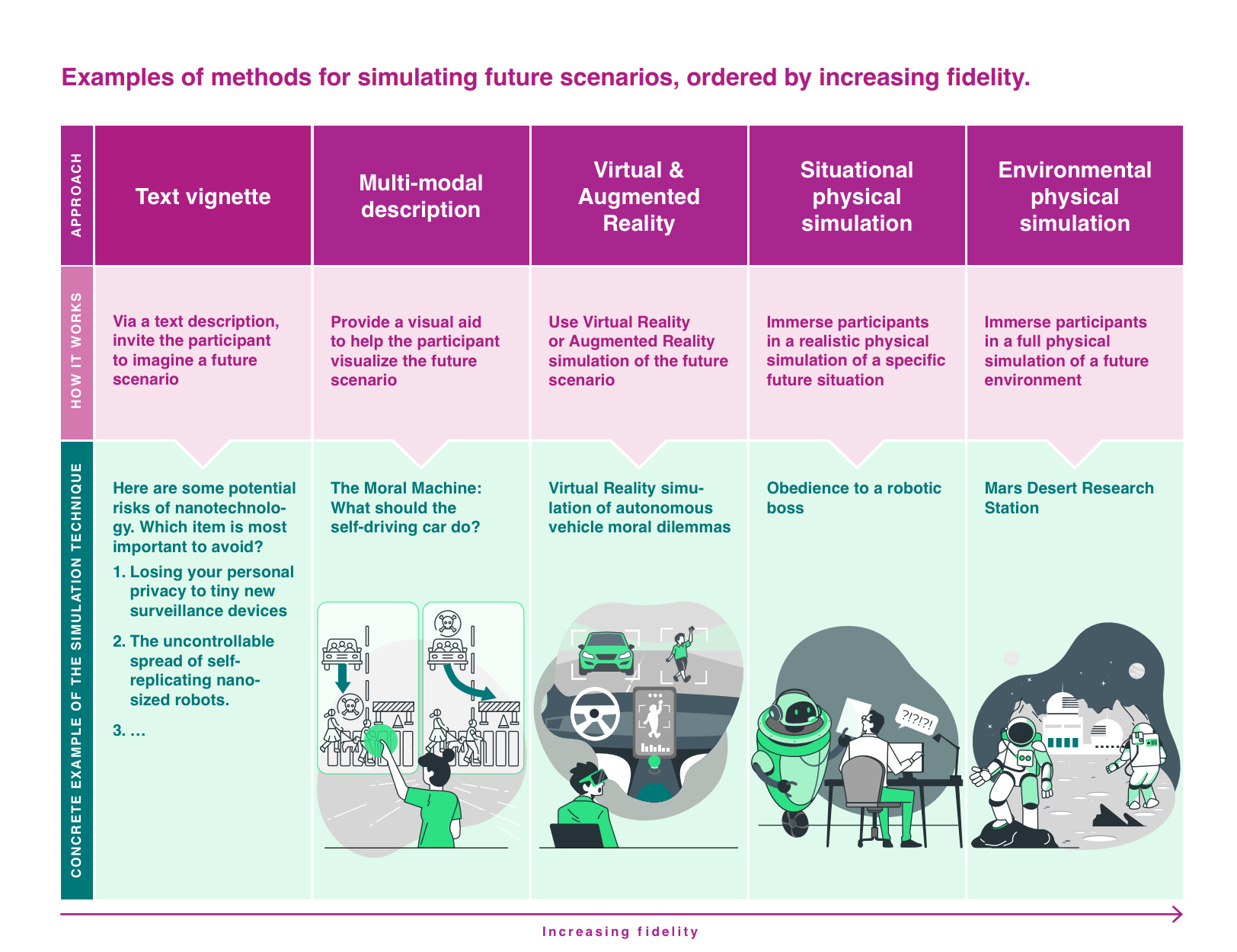
As the above modalities move from virtual to physical simulations, researchers identify behaviors incited by the technology under review. Simulations can produce more authentic results than those derived from the survey-based methods found at the beginning of the spectrum where subjects might alter their responses to give the “correct” answer.
The increasingly sophisticated simulations must anticipate and recreate the factors contributing to a technological effect. Staging a Martian outpost entails deliberately eliminating outside inputs. Testing social media usage requires a dynamic mix of environmental stimuli—multiple independent variables—to prompt and reinforce realistic behaviors. At the same time, the controlled experiment of a simulation seeks to eliminate the “noise” encountered in real-world observations that can obscure the effects of experimental variables.
As another stumbling block, Bonnefon, Rahwan, and Shariff cite the history of companies concealing negatives about their products, the ultimate real-world scenario that could neutralize sci-fi-sci. Tobacco companies knew for decades how cigarettes cause cancer and obscured the truth with advertising, public relations, and lobbying. PFAS manufacturers 3M and DuPont understood the toxicity of these forever chemicals years before public disclosure. In 2021, whistleblower Frances Haugen testified on Capitol Hill that Facebook knew the site harmed the mental health of teenage girls and incited ethnic violence. The company has prioritized anger to keep people on the platform longer and used the type of scientific research Bonnefon, Rahwan, and Shariff espouse to support the strategy. And science fiction supplies the malign corporation archetype with Weyland-Yutani of the Alien franchise, “building better worlds” atop human sacrifices to progress and profit.

Overlay Scripture with science fiction and the scientific method to appreciate the ageless quest for prophetic wisdom.
1 Corinthians 14:1 NLT
Let love be your highest goal! But you should also desire the special abilities the Spirit gives-especially the ability to prophesy.
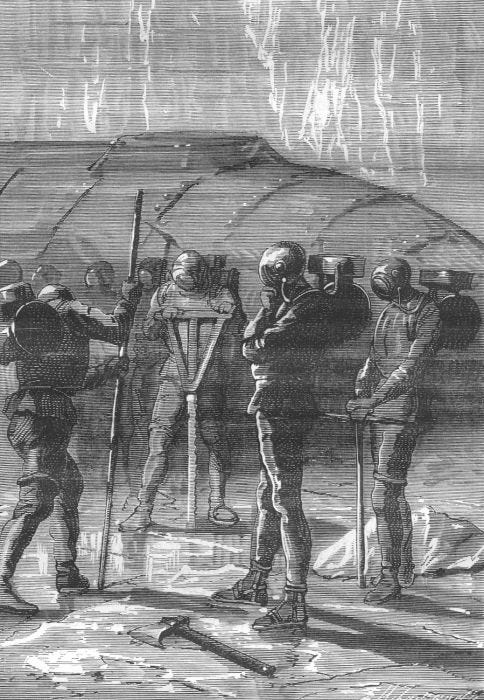
The sci-fi-sci method seeks to look ahead, to help recognize and avoid negative behaviors and perceptions pertaining to technologies still on the drawing board. The concept is ambitious in the science fiction tradition (consider the psychohistory of Isaac Asimov’s Foundation, an algorithm that predicts galactic events across centuries). Bonnefon, Rahwan, and Shariff are wise to incorporate such storytelling into their model. Sci-fi is the literature of the Industrial Revolution, launched in 1818 with the novel Frankenstein. From 20,000 Leagues Under the Sea to Things to Come to Snow Crash and beyond, the genre spanning media and generations prods and reflects, anticipating technological advances and decrying their misuse. Science fiction is a land of prophets in the worldly (or otherworldly) sense.
Could we have prevented or blunted the negatives of social media with earnest, thorough research in its early stages? Could we have made AI less threatening? Warnings must be credible and heeded. Scripture serves as example with prophecy abundant but true prophets and faithful listeners scarce. Speaking truth to power ended violently for Jesus, John the Baptist, Isaiah, and others who were anointed. Joseph and Daniel were exceptions. While unable to avoid periods of suffering, they ultimately sat beside rulers who accepted their discomforting messages.

Scripture encourages us to prophesy and honor the prophetic word.
2 Peter 1:19 ESV
And we have the prophetic word more fully confirmed, to which you will do well to pay attention as to a lamp shining in a dark place, until the day dawns and the morning star rises in your hearts,
Will sci-fi-sci prevent perils from future technology, or will the urge to play God overwhelm calls for restraint? Ignoring divine and scientifically sound prophecy is always risky, but the unaware will assume the brunt of this risk.
Points to consider:
Should advance testing be mandatory for new technology? If so, who should oversee the testing?
How can the application of biblical principles protect us from the negative effects of technology (e.g., scriptural lessons about anger and gossip guiding our behavior on social media)? How can Christians violate biblical principles in the digital realm without realizing it?
How can technology be used for God’s glory? Could efforts to curb tech hamper Christians in growing their faith?