
Eye in the Sky
God watches over us for our good. It never bodes well when we assume this power.

Science fiction lifts humankind to seeming godhood through technology. The tech boost goes back to Greek mythology as Daedalus fashions wax wings and Prometheus shares fire. By the early 1800s, sci-fi proper begins when Frankenstein animates a dead lump. Spaceflight, time travel, death rays, artificial life—canonic tropes arise from pilfering the Almighty’s powers. There is another long-sought sign of divinity, more insidious than summoning replicants or jumping the line in spacetime: breaking the bounds of awareness to become omniscient and omnipresent. Technology hacks observation, knowledge, and location, making the user all-seeing, all-knowing, always attendant. And no sci-fi trope has crossed into reality more readily (Spoilers follow).
Panoptic Philosophy
The surveillance state is dystopia’s historic address. Brute force is the future autocracy’s last resort. Mass hysteria multiplies the force, the threat of mechanical and human spies stifling the populace. Two hundred years before the digital age, British philosopher Jeremy Bentham cemented the concept with the panopticon (Greek for “all seeing”), a cylindrical prison built around a single guard tower. In the rings of cells, inmates could never be sure if the lone guard was singling them out. Bentham based the structure on a factory layout his brother had developed, showing supervision through fear could work in non-penal settings too.
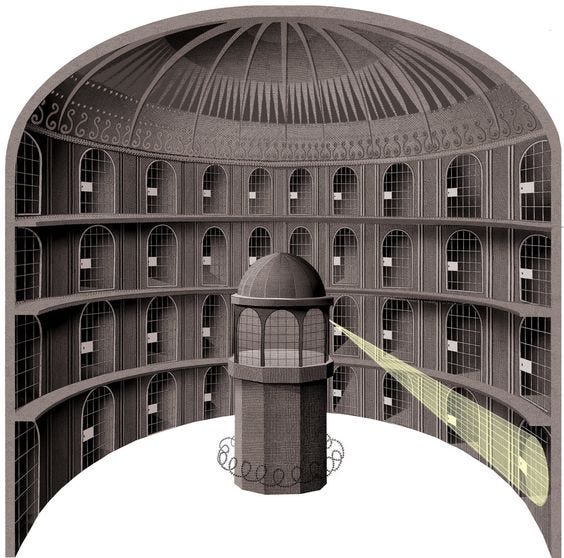
In tribute, 20th-century philosopher Michel Foucault coined panopticism, social control through surveillance paranoia. In Discipline and Punish, Foucault asserts, “the perfection of power should tend to render its actual exercise unnecessary.” Terrify the people into serving as their own police force—the dystopian zeitgeist is confirmed in an academic treatise, long exercised in sci-fi media.
THX 1138
Six years before shifting science fiction and pop culture with Star Wars, George Lucas directed and co-wrote THX 1138, based on a student film he made at USC. The denizens of a sterile, subterranean world are watched, drugged, and celibate by decree. Robert Duvall (whose early career includes genre credits in The Twilight Zone and The Outer Limits) is the title character who violates the rules, taking the wrong pills before taking no pills.
THX’s platonic roommate, LUH 3417, triggers the anarchy by initially tampering with his prescriptions, shunning her credo as one of the society’s security cam monitors. His docility shattered, THX makes love to LUH, and they conceive. Android cops try to restore order. Ultimately, THX escapes custody, the pursuing robots called off due to budget constraints. He climbs to a world where he trades the gaze of cameras for the glare of the sun.
Silo
The TV series Silo, based on the book trilogy by Hugh Howey, shares many of THX 1138’s themes with an authoritarian, underground world where procreation is restricted and surveillance prolific. Rebecca Ferguson (Lady Jessica in the Dune films) is Juliette, a street-smart engineer from the lowest level of the habitat who unravels the silo’s mysteries and prehistory, teased in illegal, indecipherable relics like an Etch-a-Sketch and a Pez dispenser.
Tim Robbins is the head of the IT department, the true power behind the largely ceremonial mayor, judge, and sheriff. IT tracks every movement, conversation, and birth control device. Relics are closely monitored too, as something as innocuous as a children’s book with drawings of the sun and ocean communicates forbidden concepts. “Go outside” is the ultimate sentence, a terminal trip to the poisoned earth surrounding the silo. Juliette stumbles into a wasteland’s freedom like THX 1138. Again, no microphones, no cameras, but no hope as well? The Bible shows the transformative power of the wilderness.
Isaiah 40:3 NLT
Listen! It’s the voice of someone shouting, “Clear the way through the wilderness for the LORD! Make a straight highway through the wasteland for our God!
1984
1984 is the fount of surveillance state fiction and a pop culture colossus on par with Star Wars. The novel’s title is synonymous with repression through technology, as is the adjective derived from the author’s name, “Orwellian,” and the personification of its evil regime, “Big Brother.” For the past 75 years, we’ve used “memory hole,” “thought police,” “unperson,” and “doublethink” (inspiration for the terms “doublespeak” and “groupthink”) as pejoratives—fearsome artifacts of George Orwell’s worldbuilding.
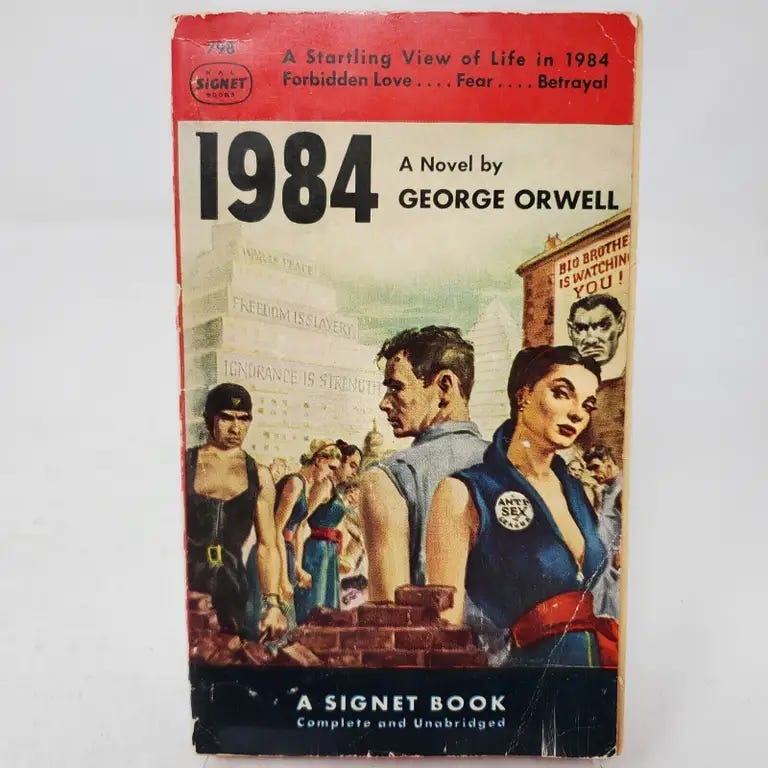
Winston Smith is a dismal bureaucrat in the Ministry of Truth (Minitru), rewriting history to validate the whims and intrigues of Oceania, the post-apocalyptic dictatorship controlling the Americas, Australia, and England, which is now known as Airstrip One. Like Juliette of Silo, he grabs scraps of the past to challenge the lies of his masters. Like THX, he begins a rebellious affair with a woman presumed faithful to the state. Dodging two-way telescreens, hidden mics, and indoctrinated kid spies, Winston and his lover Julia join a resistance cell led by O’Brien, an Inner Party member.
But unlike Silo and THX 1138, 1984 offers no escape into an unmonitored void. Winston and Julia are caught in their hideaway above an antique store and imprisoned in the Ministry of Love (Miniluv), where they are separated, beaten, tortured, and converted. Martyrdom weakened the Inquisition, the Nazis, and the Communists, explains O’Brien, revealed as an undercover thought police officer. After his release, Winston forsakes Julia, washes down the latest disinformation with Victory Gin, and loves Big Brother.
Big Brother is Watching You
The torment nexus, coined by writer Alex Blechman, is “shorthand for something that backfired in fiction being unironically replicated in reality.” No work of speculative fiction is more closely aligned with this concept than 1984. Critics of privacy invasion and government intrusion have quoted the propaganda tagline “Big Brother is watching you” since the age of UNIVAC. In a commercial directed by Ridley Scott (Alien, Blade Runner), Apple introduced Macintosh as the heroic computer to save us from mindless conformity, with Big Brother the metaphor for Big Blue, original tech titan IBM. The ad closed with a promise: “And you’ll see why 1984 won’t be like ‘1984.’”

Fast forward to the 21st century’s second quarter, and Apple has long since assumed IBM’s tech dominance. The company has put Big Brother’s telescreens in everyone’s pocket. We don’t shrink from the display like Winston, we caress it. We can’t surrender our words, actions, preferences, plans, and secrets fast enough. Foucault would marvel at FOMO subsuming paranoia.
Surveillance is lucrative, from its most benign exercises to the most ominous. The ads appearing in your Facebook feed reflect the websites you’ve recently visited. You can opt out of the tracking, a laborious process as measured in the split-seconds of internet time. Other types of tracking are done without knowledge or consent. Facebook has paid billions in fines for misuse of personal data (meaning violating the fine print nobody reads). The company’s detractors say the huge penalties are too lenient given its enormous revenue.
Silicon Valley has conjured its largest torment nexus in China. According to the Associated Press, “Over the past quarter century, American tech companies to a large degree designed and built China’s surveillance state, playing a far greater role in enabling human rights abuses than previously known.” The vendor list is a tech who’s who—IBM, Dell, Cisco, Intel, Nvidia, Oracle, Microsoft, Amazon Web Services, among others.
The amassed systems, such as the primary “Golden Shield,” facilitate “predictive policing,” scoring people on their perceived threat level derived from behaviors and appearance, justifying close monitoring, detentions, and punishments. The futuristic Precrime force led by Tom Cruise in Minority Report operated similarly. Many of the corporations named in the AP investigation have stopped working with Beijing, but the foundation has been laid with Chinese interests now sustaining, improving, and exporting the technology.
Will the Chinese surveillance state migrate to America, especially since the means were homegrown? Many fear the apparatus and mindset are already here. Bentham might share a philosopher’s gasp with Foucault if he saw modern proofs of their theories. Everyone lives in their own panopticon, one guard tower per person, always staffed, always watching.
Eye in the Sky
“Eye in the sky” denotes surveillance from above. Police helicopters, drones, and satellites have historically stolen such views. The lookout, however, belongs to God.
Proverbs 15:3 NLT
The LORD is watching everywhere, keeping his eye on both the evil and the good.
Unlike the dread of being surveilled by worldly authority, we relish God’s oversight.
Psalm 139:3-6 NLT
You see me when I travel and when I rest at home. You know everything I do. [4] You know what I am going to say even before I say it, LORD. [5] You go before me and follow me. You place your hand of blessing on my head. [6] Such knowledge is too wonderful for me, too great for me to understand!
Granted, God’s omnipresence has been equated to a cosmic Big Brother, fueling fire-and-brimstone sermons and personal guilt for millennia. But redemption and forgiveness, not control and punishment, underscore divine vigilance.
Ephesians 1:7 ESV
In him we have redemption through his blood, the forgiveness of our trespasses, according to the riches of his grace,
Big Brother and his real-life acolytes have no grace.
Points to consider:
Should sci-fi authors worry about creating a torment nexus in their work? Or is it impossible to prevent people from obtaining the wrong message from fiction?
Can surveillance technology be used for beneficial purposes? How would this align with God using all things for good?
How can we protect ourselves in a surveillance state? Do we have to give up conveniences and freedoms? How does this align with the Christian guidance of being in the world, not of it?
A wonderful read pointing to concerns we as individuals should and have had. The effects of Science Fiction on Governments and the perception of reality now, vs as it was anticipated to be. A solid reminder to Secularist and Christians alike of the importance of seeing Gods design vs humanities corruption is important, and tucked nicely in the article as well.