
A Real Snake
Banishment from the Garden wasn’t enough. Sci-Fi completes the Fall when we lose all traces of Eden.

Blade Runner: Dark Eden
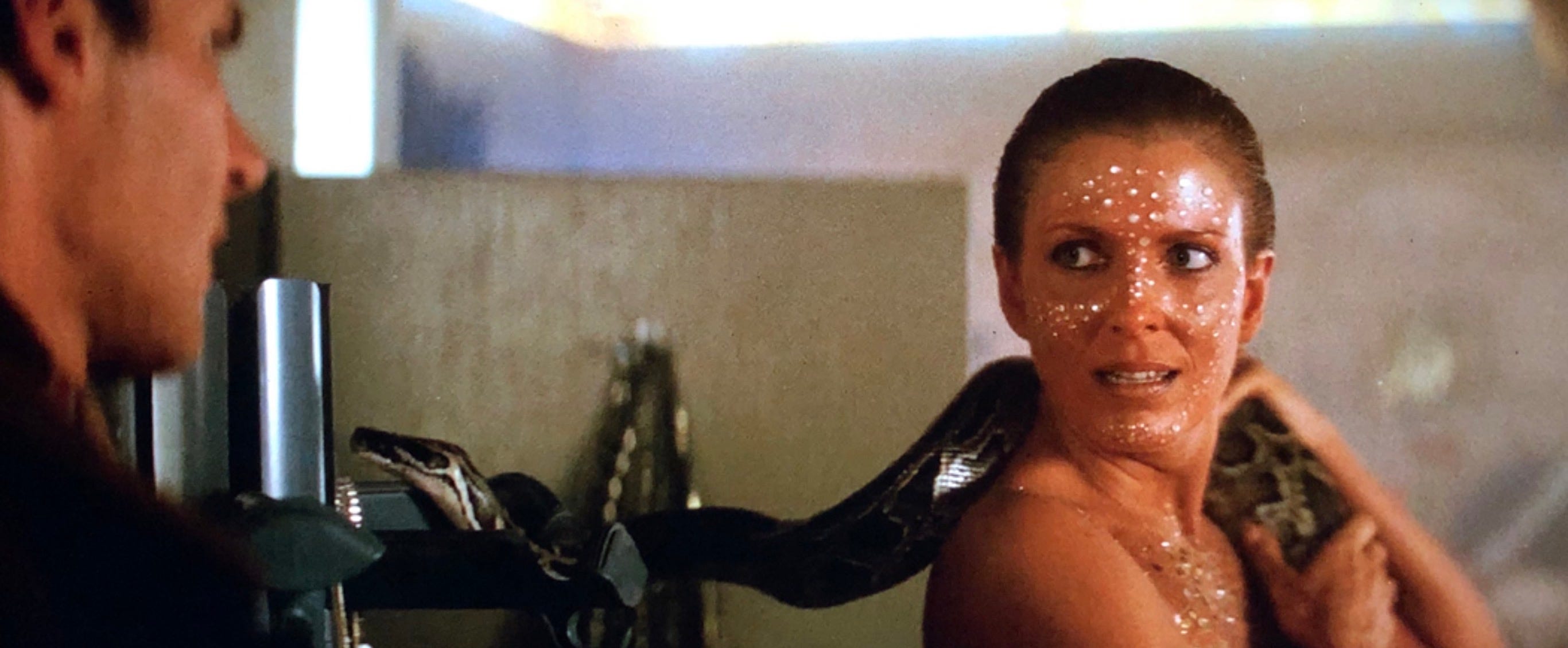
The year is 2019, the future. Detective Rick Deckard (Harrison Ford) prowls the Los Angeles streets, dark and dirty despite the incessant neon and rain. He’s closing on a fugitive thanks to a key clue—a snake’s scale imprinted with a microscopic serial number, shed by an artificial organism. Deckard follows the trail from the manufacturer, to the nightclub owner who bought the snake, and finally to Zhora (Joanna Cassidy), the exotic dancer who uses it in her act.
Posing as a union official, Deckard follows Zhora into her dressing room. She eases the snake onto a clothing rack before entering the shower.
Deckard: Is this a real snake?
Zhora: Of course it’s not real. Think I’d be working in a place like this if I could afford a real snake?
The serpent isn’t the only synthetic lifeform in the room. Zhora flattens Deckard with a superhuman blow. She is the fugitive, a replicant, member of a race bio-engineered for hazardous labor, warfare, and sex work. Deckard is a blade runner, a police specialist who hunts down replicants when they flee space slavery for Earth. As a 20-year-old watching Blade Runner in first release, I marveled that a real snake would be more precious than a fabricated one. 44 years later, I appreciate how something created by God would become rare.
The Bible begins in the Garden, lush with divine handiwork—flora and fauna, man and woman. Our subsequent world is a fragile continuation, subject to interruption, even cancellation. When science fiction reduces Eden’s abundance to relics, the Lord’s children veer toward oblivion (spoilers follow).
1970s: Environmental Awareness
In the decade prior to Blade Runner, dystopian and apocalyptic films framed their worlds in scarcity. Soylent Green also features a detective in the first quarter of the 21st century—NYPD’s Robert Thorn (Charlton Heston) investigating the murder of a board member from the Soylent Corporation, which produces vegetable and plankton wafers to feed half the teeming world. New York City’s population alone is 40 million.
When interviewing the partner of the dead man’s bodyguard, Thorn finds a dirty spoon revealing she surreptitiously eats strawberries costing $150 a jar, too expensive for that household. The cop himself isn’t beyond illicit delicacies. He pilfers fresh food from the rich victim’s penthouse, presenting the spoils to his roommate, Sol Roth (Edward G. Robinson in his final role). Roth is a “book,” an aged researcher, witness to the way the world used to be, able to prepare and enjoy a traditional dinner. Thorn declares the lettuce, apple, and modest portion of stew the best meal he’s ever had. He’ll never be satisfied with Soylent Green again, especially when he learns the secret ingredient.
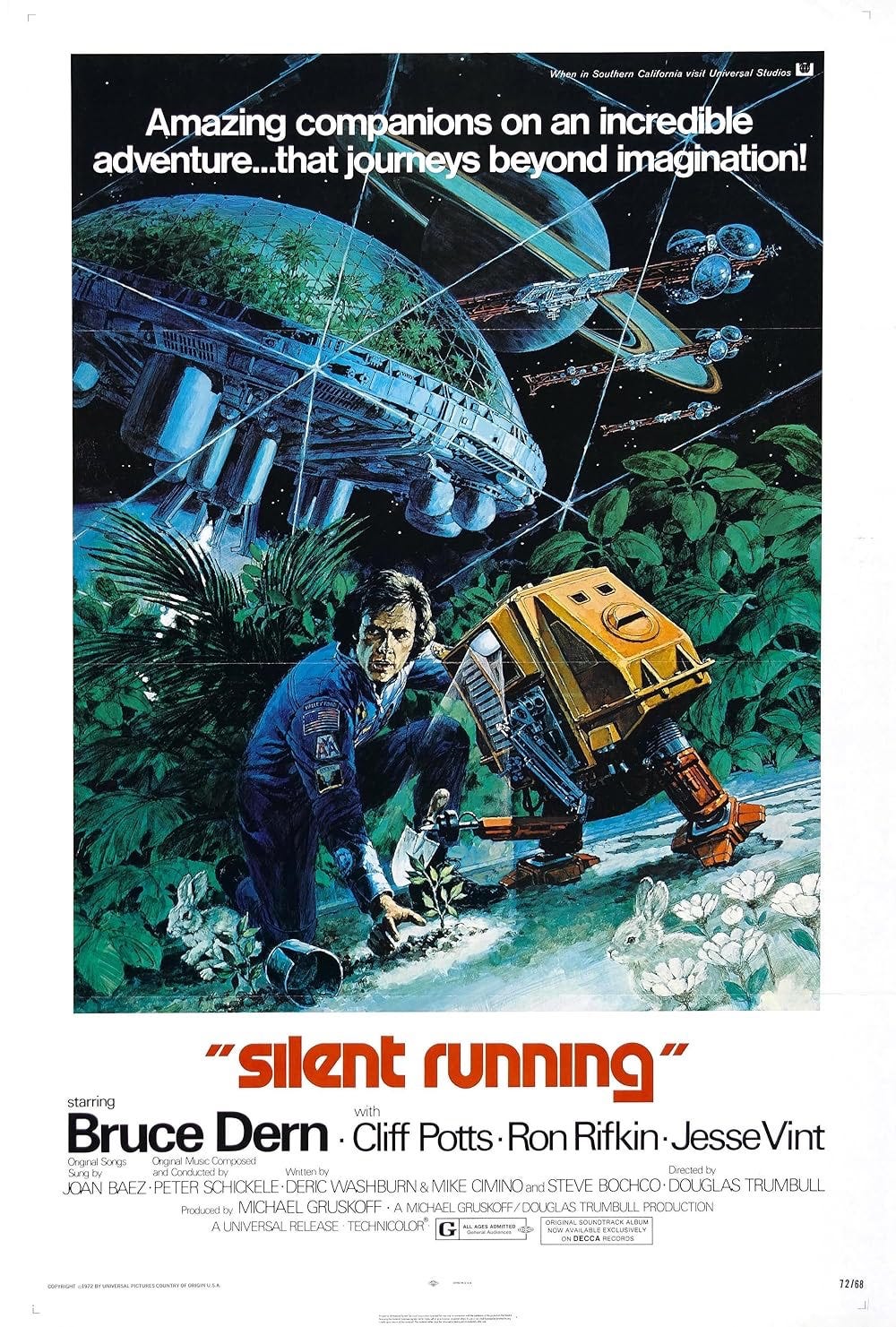
In Silent Running, humankind has eradicated Earth’s forests. The remaining specimens fill greenhouse domes on giant cargo ships near Saturn. Botanist Freeman Lowell (Bruce Dern) tends the biomes aboard the Valley Forge, enduring the barbs of his three crewmates when he decries their denuded home planet with its calibrated climate and processed food.
The fleet is ordered to nuke the forests and return the cargo ships to regular duty. Lowell transforms from treehugger to murderous mutineer, killing the others and faking the Valley Forge’s destruction. He takes the ship on a perilous route through Saturn’s rings into deep space to preserve the last forest with the help of three waddling droids that look like R2-D2’s cousins. Lowell’s eco-hijack unravels as the dutiful robot trio suffers casualties and a fellow freighter finds the Valley Forge. He jettisons the dome with a droid its eternal gardener before committing nuclear suicide.
2000s: Sci-Fi and Reality Merge
The 2000s brought a new wave of cautionary films about a sterilized Earth. Children of Men gives the concept its deepest meaning as mass infertility triggers society’s collapse. Refugees flood a dystopian England including Kee (Claire Hope-Ashitey) who is secretly carrying the first fetus in 18 years. Theo (Clive Owen) a former activist turned bureaucrat agrees to furnish Kee with transit papers.
Director Alfonso Cuarón captures key scenes in extraordinary long takes (a technique he perfected in his Oscar-winning Gravity), evoking a minicam feed from a war zone. Shedding his cynicism, Theo shepherds the scared, pregnant girl through a gauntlet of authorities and anarchists, taking a bullet in the process. The factions part mutely as Kee emerges from a blasted building holding her infant daughter, the new Madonna and Child, bound for a scientific colony in the Azores hoping to reverse global infertility.
Earth has no hope in Interstellar when ongoing blight kills crops, resurrecting the Dust Bowl of the 1930s. Dystopia is a tepid second to the natural world’s tyranny. The government denies the moon landing took place a century earlier and compels most young people to become farmers growing corn, the last viable grain. Former astronaut Joseph Cooper (Matthew McConaughey) pushes back when the system tries to tame his rebellious, brilliant daughter Murphy (Mackenzie Foy/Jessica Chastain/Ellen Burstyn). Murph does more than confound her teachers. She sees strange patterns in the dust in her room. Cooper sees a coded message—map coordinates.
Cooper and Murphy locate a secret NASA facility toiling on a two-prong program to save humanity: Plan A, traverse a wormhole to find a habitable planet to raise 5,000 frozen embryos; Plan B, develop anti-gravity technology so Earth’s population can emigrate to space. Cooper commands Endeavor to inspect candidate worlds identified by previous missions. Murphy stays behind to grow up under the tutelage of Professor Brand (Michael Caine) and help him solve the anti-gravity equation.
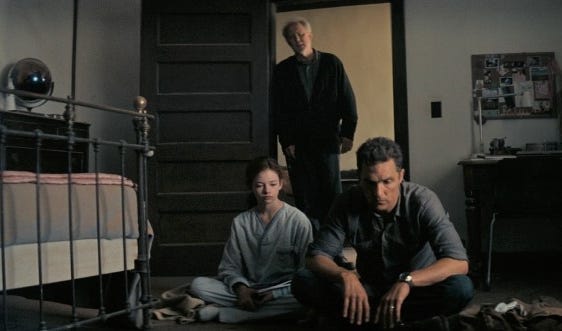
Disaster and deceit nearly doom both plans. Cooper uses the black hole at the wormhole’s terminus to slingshot crewmate Amelia Brand (Anne Hathaway) and the embryos to a safe planet. Love transcends spacetime as he dives into the black hole so he can transmit key data to adult Murph via the decades of dust anomalies in her bedroom, allowing her to solve the anti-gravity equation.
The wormhole ejects Cooper near Saturn where he finds humanity thriving aboard gigantic space stations. He also finds Murph, now 100 due to time dilation. The still middle-aged Cooper has a deathbed reunion with his daughter before leaving to rendezvous with Amelia and help her launch the Plan A civilization. The new world is stark but serene and fertile. Children and crops will not be rarities for long.
Beware of Barrenness in The Bible
The Bible warns of barrenness, a drastic escalation of the tenuous relationship with nature in the ancient Middle East, the fear of having no children to work and inherit the land. Revelation 8 foretells seven plagues decimating earth, sea, and rivers.
Revelation 8:6-11 NLT
Then the seven angels with the seven trumpets prepared to blow their mighty blasts. [7] The first angel blew his trumpet, and hail and fire mixed with blood were thrown down on the earth. One-third of the earth was set on fire, one-third of the trees were burned, and all the green grass was burned. [8] Then the second angel blew his trumpet, and a great mountain of fire was thrown into the sea. One-third of the water in the sea became blood, [9] one-third of all things living in the sea died, and one-third of all the ships on the sea were destroyed. [10] Then the third angel blew his trumpet, and a great star fell from the sky, burning like a torch. It fell on one-third of the rivers and on the springs of water. [11] The name of the star was Bitterness. It made one-third of the water bitter, and many people died from drinking the bitter water.
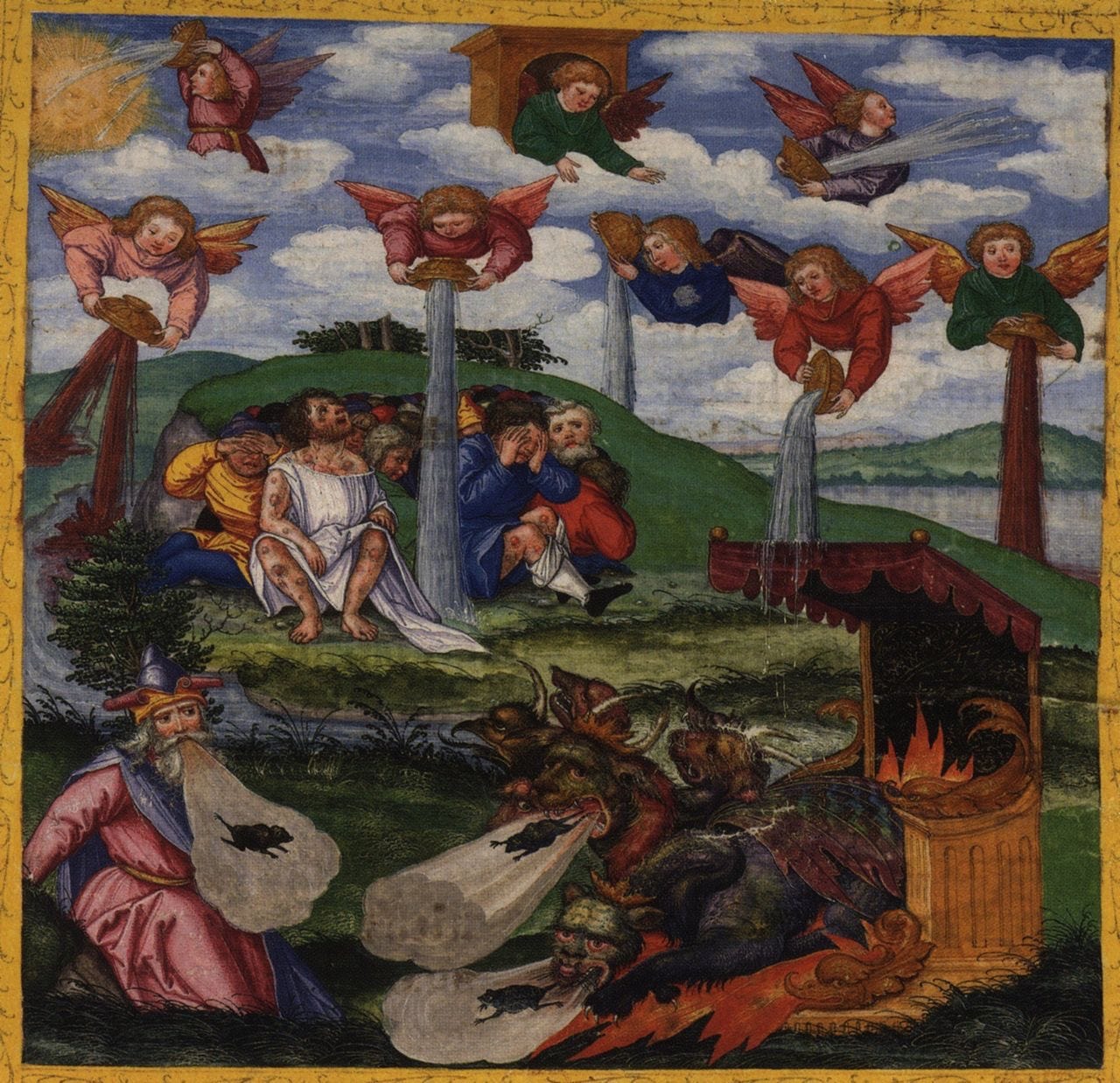
Exodus tells of another series of plagues, the ones visited upon Egypt. Crops, livestock, the life-giving Nile, and eventually the nation’s first-born succumb.
Exodus 11:4-5 NLT
Moses had announced to Pharaoh, “This is what the LORD says: At midnight tonight I will pass through the heart of Egypt. [5] All the firstborn sons will die in every family in Egypt, from the oldest son of Pharaoh, who sits on his throne, to the oldest son of his lowliest servant girl who grinds the flour. Even the firstborn of all the livestock will die.
Empty wombs are another calamity along with the ravaged planet. Childlessness is considered a sign of disfavor, with no heirs to claim holdings or care for widows. But God changes history by summoning life when it is unexpected. Abraham becomes a father in old age and the father of many nations when his wife Sarah is pregnant.
Genesis 17:17 NLT
Then Abraham bowed down to the ground, but he laughed to himself in disbelief. “How could I become a father at the age of 100?” he thought. “And how can Sarah have a baby when she is ninety years old?”
The book of Luke describes two miraculous conceptions: Jesus preceded by his cousin, John the Baptist.
Luke 1:23-31 NLT
When Zechariah’s week of service in the Temple was over, he returned home. [24] Soon afterward his wife, Elizabeth, became pregnant and went into seclusion for five months. [25] “How kind the Lord is!” she exclaimed. “He has taken away my disgrace of having no children.” [26] In the sixth month of Elizabeth’s pregnancy, God sent the angel Gabriel to Nazareth, a village in Galilee, [27] to a virgin named Mary. She was engaged to be married to a man named Joseph, a descendant of King David. [28] Gabriel appeared to her and said, “Greetings, favored woman! The Lord is with you!” [29] Confused and disturbed, Mary tried to think what the angel could mean. [30] “Don’t be afraid, Mary,” the angel told her, “for you have found favor with God! [31] You will conceive and give birth to a son, and you will name him Jesus.
Science fiction presents the disastrous consequences of taking living things for granted—from snakes to strawberries, old-growth forests to newborn babies. Scripture gives first warning as we run from Eden into the dust.
Points to Consider:
Review the plots of classic sci-fi works dealing with biblical disasters like famine and pestilence. How close have they been to predicting current events? Should we treat science fiction as prophetic?
How does God resolve barrenness in the Bible? How can we draw strength from these lessons when we go without as a people and individuals?
Should we take real-life doomsayers seriously? Compare/contrast with biblical prophets and how their societies treated them.
NOTE: the films mentioned contain nudity, sexual situations, coarse language, and/or violence.